
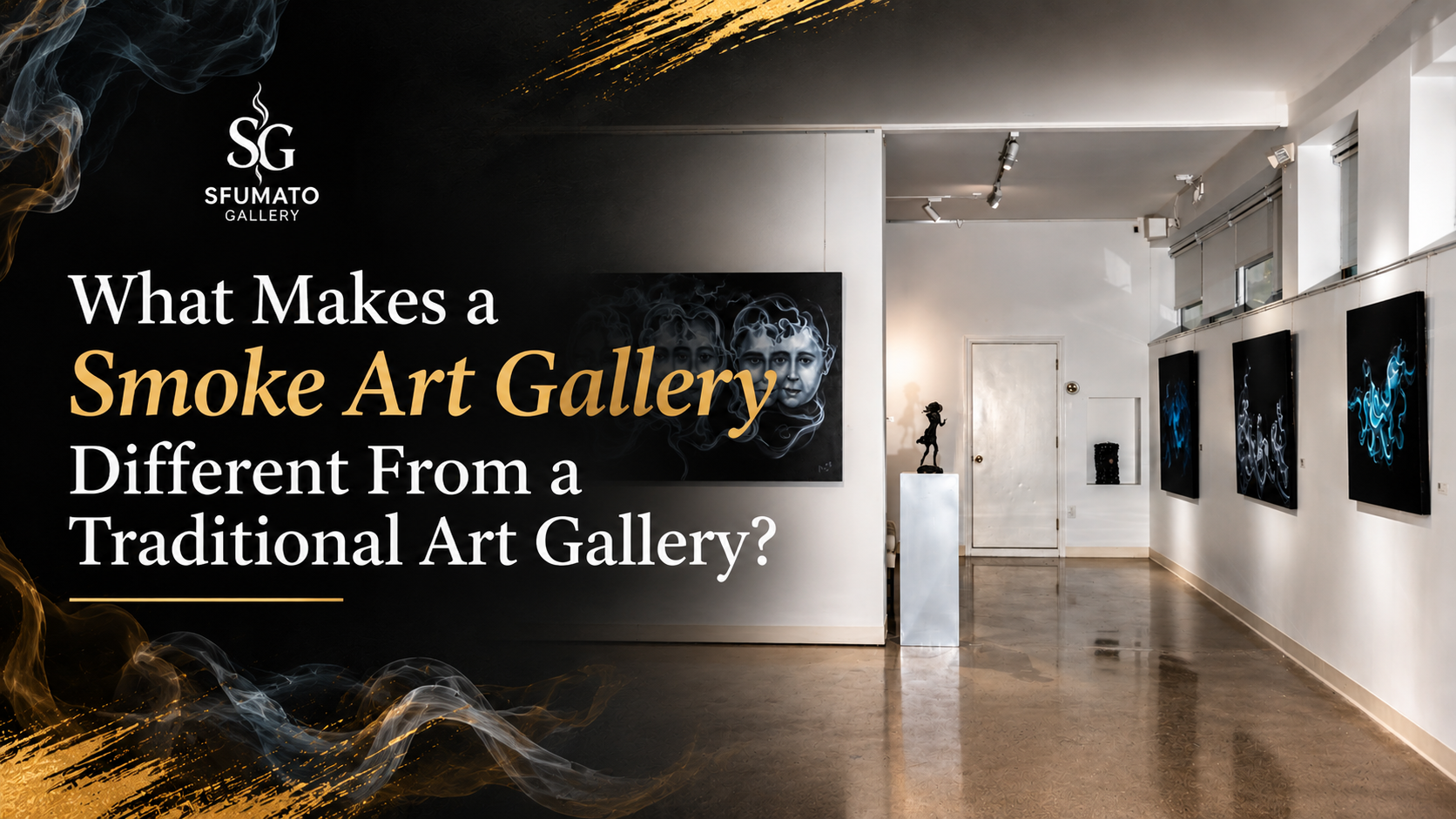
Most of us picture an art gallery the same way: white walls, framed canvases, soft footsteps and a small card beside each piece. It’s a familiar, comfortable setup, and it works well for oil paintings, sculpture and prints. But step into a Smoke Art Gallery Westwood and that picture changes quickly. The materials are unusual, the lighting is dramatic, and the artwork asks you to look differently.
At Sfumato Gallery, we think the difference is worth explaining, especially if you’ve never seen smoke used as an art form. Here’s what sets the two experiences apart.
The Medium Is Unusual, and Very Old
Smoke may feel like a modern novelty, but it’s one of the oldest materials people have used to make images. Soot and smoke appear in ancient cave paintings, and early American folk artists used smoke to decorate furniture. In the 1930s, the Surrealist painter Wolfgang Paalen popularized fumage, a technique where a candle’s flame leaves patterns of soot on a surface, and other Surrealists soon picked it up.
Today, artists keep finding new ways to work with it. Some guides smoke across canvas with stencils and plenty of patience. Others build up layers of carbon to create portraits, or draw inside glass bottles by removing soot instead of adding it. Photographers take a different route, capturing the fleeting curls of incense or dry-ice vapor in a controlled studio.
A traditional gallery usually shows paint, ink, clay or bronze, materials that stay put and behave predictably. Smoke does neither. That unpredictability is exactly why the results look so different from anything else on the wall.
How the Work Is Made
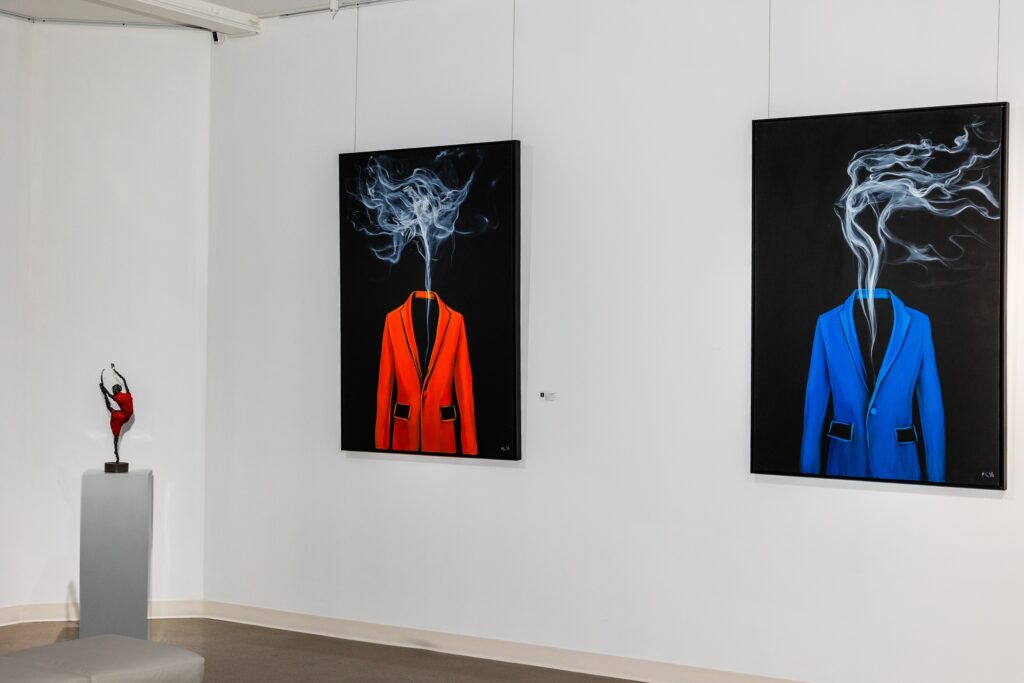
Smoke art begins with controlled chaos. A photographer working with smoke typically sets up a well-ventilated studio with a plain dark backdrop, a steady source like incense, and carefully placed lights. The camera needs fast shutter speeds to freeze motion that lasts a fraction of a second. Even then, it can take dozens of test shots to land one clean, graceful wisp.
After the shoot, many artists refine the image digitally, adjusting contrast, mirroring forms and layering textures until the smoke becomes something new. Artists who work directly with flame and soot face a similar balancing act. They have to respect what smoke wants to do while still nudging it toward the image they have in mind.
This is the heart of what a Smoke Art Gallery Westwood offers: work that comes from a conversation between the artist and a material that can’t be fully controlled. Every piece carries a bit of accident and a lot of skill.
The Atmosphere Feels Different
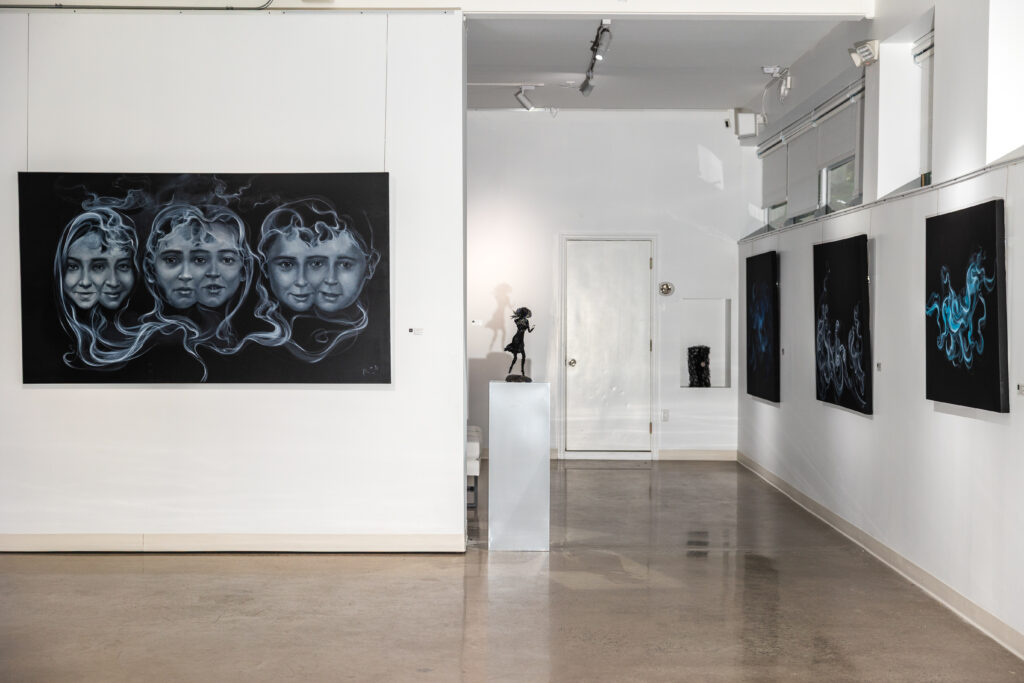
Traditional galleries tend to be bright and neutral so the art can speak for itself. Smoke-based work often asks for something more atmospheric. Because the imagery is delicate and luminous, it looks best with considered lighting, deeper contrast and a quieter, almost contemplative mood.
Visitors often find themselves slowing down. You lean in. You step back. You tilt your head, because a curl of smoke can read as a dancer, a flower, a face or just a feeling. That’s the other big difference: smoke art is abstract, so the viewer fills in the blanks. It’s closer to finding shapes in clouds than reading a label. Two people can stand in front of the same piece and walk away with completely different stories, and both are right.
Permanence vs. Impermanence
Here’s a question traditional galleries rarely have to ask: how long will it last?
Painted canvases are made to endure. Soot on a surface is more delicate, which is why some artists experiment with fixatives to stabilize their work. Others embrace fragility. The artist Sheila Gallagher has spoken about being drawn to smoke because it’s chaotic and fleeting, visible yet almost immaterial. For her, those qualities are the subject.
Photographed smoke raises a different kind of wonder. The image is permanent, but the moment it records vanishes within seconds. In a sense, you’re looking at something that can’t be repeated. A traditional gallery celebrates what is lasting; a smoke gallery makes you think about what isn’t.
Smoke Art Meets Community
A gallery isn’t only a room full of artwork. It’s also a gathering place. In neighborhoods like Westwood, creative energy tends to spill beyond the gallery walls, into openings, artist talks, studio visits and seasonal showcases. If you enjoy discovering something new, keeping an eye on art events Westwood hosts is one of the best ways to meet artists and see new work before everyone else does.
An art fair Westwood visitors can wander through is another good way to compare styles side by side. You might see traditional landscapes in one booth and an experimental smoke piece in the next. Those contrasts help you work out what you actually respond to, and smoke art often becomes the surprise favorite of the day.
At Sfumato Gallery, we love those conversations. Talking with visitors about how a piece was made, or what it makes them feel, is half the fun.
Smoke Art Is More Approachable Than You Think
A lot of people hesitate to walk into a gallery because they worry they won’t “get” the art. Smoke art is a friendly place to start, because there’s nothing to decode. You don’t need art-history knowledge to enjoy a swirl of light and shadow. You only need curiosity.
It’s also surprisingly good for people who think they don’t like art. The imagery feels organic and familiar. It reminds you of fog, candlelight, incense or a cool morning. The emotional response comes first, and the understanding follows.
How to Find a Gallery That Fits You
If you’re searching for an art gallery near me, it helps to know what you want from the visit. Here are a few questions worth asking:
- Does the gallery focus on a particular medium, or does it show a mix?
- Does it host events, artist talks or workshops?
- Are the staff happy to explain the process behind the work?
- Does the space feel welcoming to first-time visitors?
A good gallery should make you feel curious, not intimidated. And if you’re drawn to something a little different, a specialist space will usually give you a deeper experience than a general one. That’s where a Smoke Art Gallery Westwood really stands out. The whole space is built around one distinctive way of seeing, so every piece in the room belongs to the same conversation.
Why the Difference Matters
Traditional galleries and smoke art galleries aren’t rivals. Both play an important role in how we experience creativity. A classic gallery gives us craft, history and permanence. A smoke gallery gives us mystery, motion and the beauty of the moment.
But if you’ve seen plenty of conventional art and want something that surprises you, smoke is worth your time. It rewards patience, invites imagination, and reminds us that art doesn’t have to be solid to be powerful.
If you’re in the area, we’d love to welcome you to Sfumato Gallery. Come see how a Smoke Art Gallery Westwood can change what you expect from an afternoon with art. Take your time, look closely, and let the smoke tell you something unexpected.
FAQs
What is a smoke art gallery?
A smoke art gallery displays artwork made with smoke, soot or flame, including smoke photography and fumage-style paintings. The pieces are abstract, atmospheric and often one of a kind.
How is smoke art different from traditional art?
Traditional art uses stable materials like paint, clay or bronze, while smoke art works with an unpredictable, fleeting medium. Every piece captures a moment that can’t be repeated.
Do I need art knowledge to enjoy smoke art?
Not at all. The imagery is abstract, so you can simply look, feel and find your own meaning in the shapes.
Is smoke art permanent?
Photographed smoke is printed like any other image, so it lasts. Soot-based works are more delicate, and some artists use fixatives to help preserve them.
How can I find art events in Westwood?
Check local gallery calendars, community listings and social media for openings, artist talks and any art fair Westwood hosts. You can also visit Sfumato Gallery to hear about upcoming events.