
What Is Contemporary Art And Why Does It Matter?
A complete guide to understanding, experiencing, and collecting art that resists easy definition from living artists whose work transforms any space it enters.
The most powerful art doesn’t announce itself; it reveals itself slowly.
Contemporary art is not a style. It is not a movement. It is a living, breathing conversation between artists, collectors, and the world around us, and it has never been more vital, or more accessible, than it is today. Whether you are encountering it for the first time or deepening a lifelong relationship, this guide is your starting point.
01: Defining Contemporary Art
At its simplest, contemporary art refers to work made by living artists or work produced roughly from the 1970s onward, depending on who you ask. But the more useful definition is experiential rather than chronological: contemporary art is work that grapples with the questions, tensions, and possibilities of the present moment.
Unlike classical painting, which operated within established rules of composition, perspective, and subject matter, contemporary art refuses to be pinned down. A sculpture made of wire. A canvas saturated in smoke. A photograph that blurs the boundary between documentary and dream. These are all contemporary art and they are all valid.
Contemporary art is less about what it looks like and more about what it asks of you. The best works demand your presence, your memory, your discomfort and occasionally, your joy.
02: A Brief History of the Contemporary
To understand contemporary art, it helps to trace the ruptures that made it possible. The story begins in earnest with the abstract expressionists of the 1940s and 50’s, Pollock, de Kooning, Rothko, who insisted that paint on canvas could be an act of raw feeling rather than representation. From there, Pop Art interrogated mass culture; Minimalism stripped form down to pure geometry; Conceptualism asked whether the idea itself could be the art.
By the 1980s and 90s, the boundaries between art, politics, and identity had collapsed entirely. Artists began engaging with race, gender, colonialism, and trauma not as abstract themes but as lived realities. And by the digital age, the very definition of medium had exploded: video, installation, performance, generative code, and AI are now as legitimate as oil on canvas.
Every era gets the art it needs. Ours is no different; it is simply more urgent, more plural, and more honestly uncertain than any that came before.
03: Major Movements & Recurring Themes
Contemporary art does not have a single style, but certain themes recur with striking consistency across cultures and media:
Identity & the Body
Who are we, and who gets to define us? These questions drive some of the most powerful work being made today. Artists explore how race, gender, class, and heritage shape both individual experience and collective memory, often working from deeply personal material to reach something universal.
Memory & Transformation
Many contemporary artists are preoccupied with the way the past lives in the present. How do we carry what we have lost? How do places and objects hold traces of lives already lived? This thread runs through painting, sculpture, and photography alike, often appearing as a kind of visual archaeology.
The Boundary Between Control and Release
Perhaps the most quietly radical idea in contemporary art is the surrender of authorial control. The sculptor Karen Akhikyan, represented by Sfumato Gallery, speaks of letting his wire sculptures decide their own emotional register, not imposing a feeling, but discovering it. This philosophy of receptive making distinguishes the most memorable contemporary work from mere craft.
04: How to Experience Contemporary Art
Many people feel intimidated by contemporary art, particularly work that offers no obvious subject matter or narrative. But the experience of art is not a test. There is no correct interpretation, and ignorance of art history is no barrier to a genuine encounter.
The most useful approach is simply to slow down. Stand in front of a work for longer than feels comfortable. Notice what your body does whether you lean in or pull back, feel calm or agitated, want to look away or cannot stop looking. These physical responses are data, not noise.
Read the wall text not to decode the work but to add a layer of context. Then return to the work with that context, and notice whether it changes anything. More often than not, the best art reveals itself in layers first as sensation, then as thought, then as something harder to name.
At Sfumato Gallery in Westwood, NJ, our exhibition spaces are designed specifically for this kind of slow encounter. We believe art needs room to breathe, and so do the people who come to see it.
05: The Art of Collecting
Collecting contemporary art is one of the most personally satisfying things you can do with your resources, and it is far more accessible than most people assume. You do not need a Basquiat budget to build a meaningful collection. What you need is curiosity, patience, and a willingness to trust your own response to work.
The best collections are deeply personal. They reflect the life, experiences, and obsessions of the collector rather than a strategy for financial return. Collect what moves you, work you want to live with, think about, and return to. The pieces that stay with you after you have left the gallery are the ones worth pursuing.
Practically speaking, building a collection means developing relationships: with galleries, with artists, with other collectors. It means showing up to openings, to art fairs, to studio visits. The art world rewards sustained engagement.
06: Spotlight: Artists at Sfumato Gallery
Sfumato Gallery takes its name from the Renaissance technique of blurring boundaries between light and shadow, and the artists we represent share that quality of refusing easy resolution.
Mher Khachatryan: The Smoke Artist
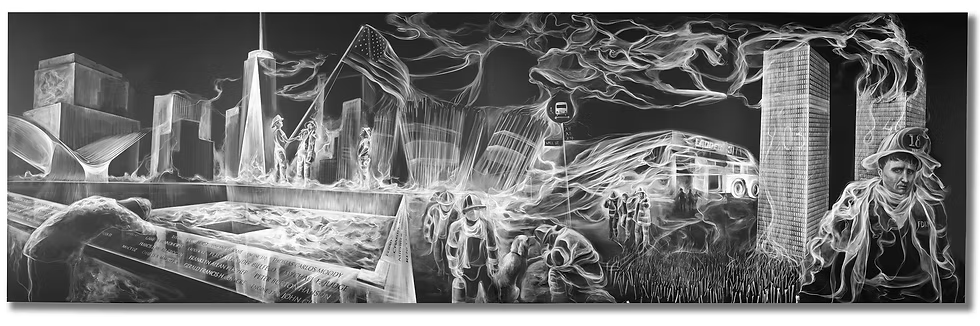
Khachatryan’s smoke paintings on black canvas are among the most distinctive bodies of work in contemporary American art. Working in oils, he renders smoke not as a phenomenon but as a metaphor, something between form and dissolution, between the seen and the barely remembered. His large-format canvases (42” × 60”) invite prolonged looking, revealing new details as the eye adjusts to the depth of the black ground.
Hakob Hakobyan: Colour as Architecture
Where Khachatryan subtracts, Hakobyan adds. His radiant, colour-driven canvases use hue as a structural element, building pictorial space through the relationships between tones rather than through linear perspective. The work is joyful without being decorative, and its scale demands full-body engagement from the viewer.
Kseniya Wooster: The Warmth of Presence
Wooster’s oil paintings are warm and life-affirming in the most rigorous sense; they insist that ordinary life is worth attending to. Her figures are rendered with tenderness and psychological acuity, neither idealised nor exposed, but present in a way that feels quietly radical in an era of irony and detachment.
Karen Akhikyan: Wire Sculpture & the Philosophy of Surrender
Born in Yerevan, Armenia, in 1963, Akhikyan came to wire sculpture through decades of working across oil, batik, and metal. His pieces are held in private collections across more than sixty countries. What unites them is a quality of aliveness, a sense that the work is still in the process of becoming something, never quite finished, never quite still. He does not decide what a sculpture should feel. He lets it decide.
Soo Kim: The Poetry of Emotion
Soo’s contemporary works explore the delicate layers of human emotion and vulnerability with remarkable sensitivity. Drawing from her background in graphic design and art direction, she uses light, space, and composition with instinctive precision, allowing color and texture to carry emotional weight. Her use of alcohol inks brings a fluid, luminous quality to each piece, creating artworks that feel calming, ethereal, and quietly restorative.
07: Art Fairs & the Contemporary Market
Art fairs have become one of the primary sites of contemporary art’s circulation, both as a marketplace and as a cultural event. Fairs like Art Basel, Frieze, and NADA bring together galleries from around the world, making it possible to see a concentrated cross-section of current practice in a single venue.
For new collectors, art fairs are an ideal environment for rapid education. In a single afternoon, you can encounter dozens of galleries and hundreds of works, learning, through direct comparison, what you respond to and why. Bring a notebook. Return to the booths that pulled you back.
Sfumato Gallery participates in select regional and national art fairs, bringing our artists to new audiences and continuing the conversations that begin in our Westwood space.
08: Starting Your Own Collection
If you are ready to begin, start close to home. Visit local galleries regularly, not just when you intend to buy, but as a habit of attention. Develop relationships with gallerists who share your sensibility. Ask questions. Ask about the artist’s process, their influences, and the story behind a specific work.
Establish a budget that feels sustainable over the years rather than one that exhausts itself in a single purchase. A collection built slowly, over time, with care and attention, will be far more coherent and alive than one assembled quickly at the top of your range.
Most importantly: collect what you love. The art world is full of advice about what is valuable, what is rising, and what you should own. Discard almost all of it. Trust the works that stay with you that you think about in the car, that you wish were hanging in your house. Those are the works worth pursuing.
FAQ
1. What is contemporary art?
Contemporary art refers to artwork created by living artists or work produced from the 1970s onward. It focuses on present-day ideas, emotions, social issues, and modern experiences rather than following traditional artistic rules.
2. Why does contemporary art matter today?
Contemporary art matters because it reflects the world we live in now. It explores identity, culture, politics, memory, technology, and human experience in ways that encourage discussion and new perspectives.
3. Is contemporary art a specific style or movement?
No, contemporary art is not one single style or movement. It includes many forms such as painting, sculpture, photography, installation, performance art, digital art, and AI-based works.
4. How is contemporary art different from classical art?
Classical art often follows established rules of composition, realism, and technique. Contemporary art is more open-ended, experimental, and concept-driven, focusing on ideas and interpretation.
5. What themes are common in contemporary art?
Common themes include identity, race, gender, memory, transformation, politics, culture, technology, and the relationship between control and creativity.
6. How should beginners experience contemporary art?
The best way is to slow down, observe carefully, and notice your personal reactions. There is no single correct interpretation, so your emotional and intellectual response is important.
7. Do I need art knowledge to understand contemporary art?
No, prior art knowledge is not required. Contemporary art welcomes personal interpretation, curiosity, and open-minded viewing.
8. Can I start collecting contemporary art as a beginner?
Yes, contemporary art collecting is accessible to beginners. You do not need a large budget—start with pieces you genuinely connect with and build your collection over time.
9. Where can I buy contemporary art?
You can buy contemporary art from galleries, art fairs, artist studios, exhibitions, and trusted online platforms that represent living artists.
10. What makes contemporary artwork valuable?
Value can come from artistic quality, originality, emotional impact, the artist’s reputation, rarity, and how meaningful the work is to collectors or viewers.